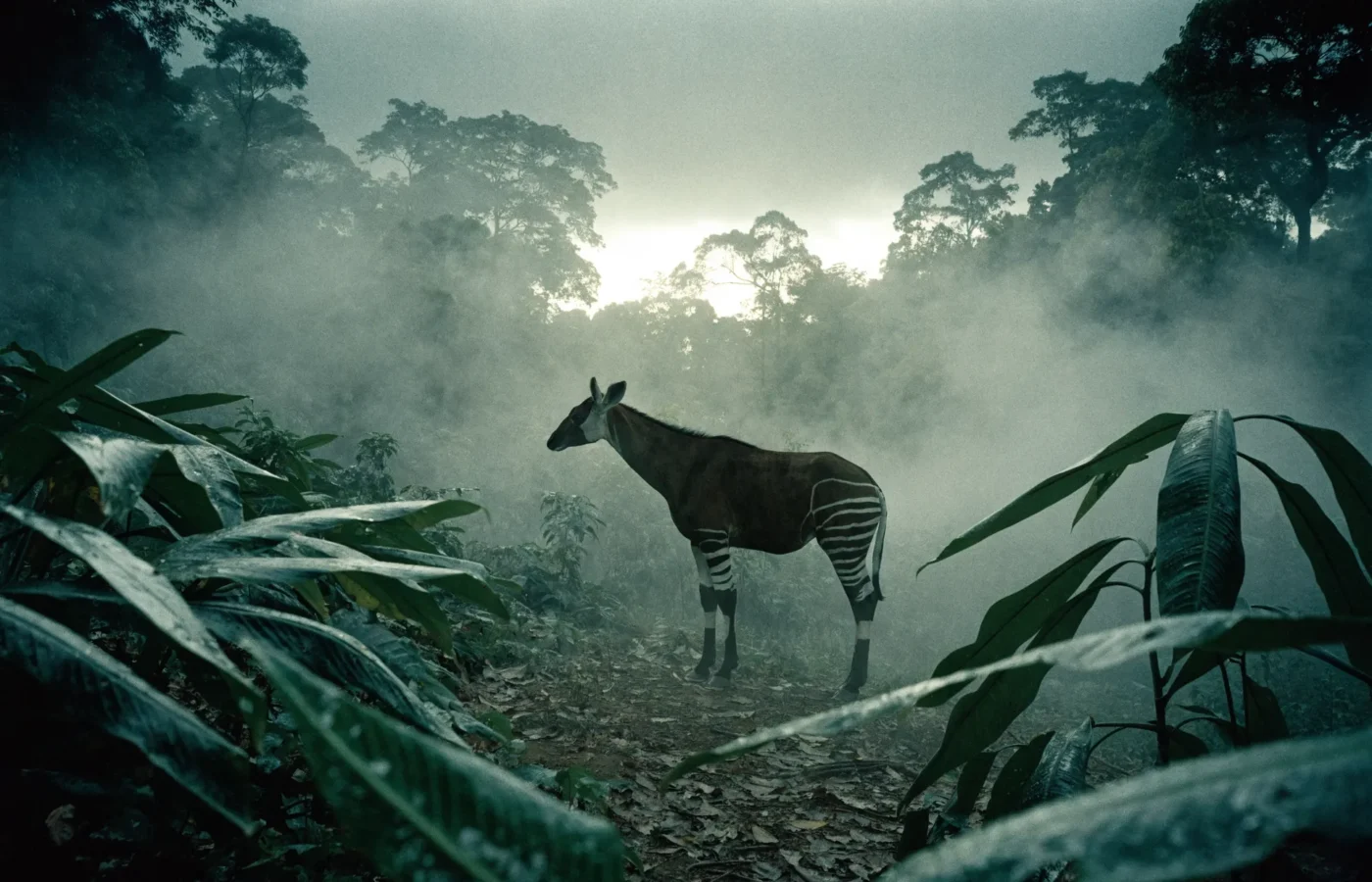
Okapi
- Designation
- SF-ZAF-012
- Classification
- Zoological — striped forest giraffid
- Location
- Ituri Forest, Democratic Republic of the Congo
- Coordinates
- 1.4833° N, 28.5167° E
- First sighting
- 1 June 1890
- Last report
- 21 June 1901
- Reports filed
- 12
- Status
- Sealed
Field Notes
Accounts came out of the Ituri Forest of the northeastern Congo, closed
country of standing water and low light where a large animal can stand
twenty metres away and not be seen. Local hunters described something the
size of a horse: a dark body, almost black in shade, with white banding
across the hindquarters and down the legs, a long neck carried level rather
than high, and a tongue long enough to reach its own ear. They had a name
for it and used it without hesitation.
For eleven years the file stayed open on testimony alone. Every collector
sent to bring one back returned empty-handed. The consensus hardened in the
usual direction — that the accounts were a composite of animals already
known, a zebra’s markings attached to something else, and that the name
belonged to a story rather than a species. What ended the argument was not
better testimony. It was a bandolier cut from striped hide,
and then a full skin and two skulls, shipped to London in 1901.
Sealed. The animal was real, it was where the hunters said it was, and it
looked very close to what they had described. The file is retained because
of the eleven years, not the species: it is the clearest record held here of
what a correct account looks like while it is still being disbelieved.